.svg)

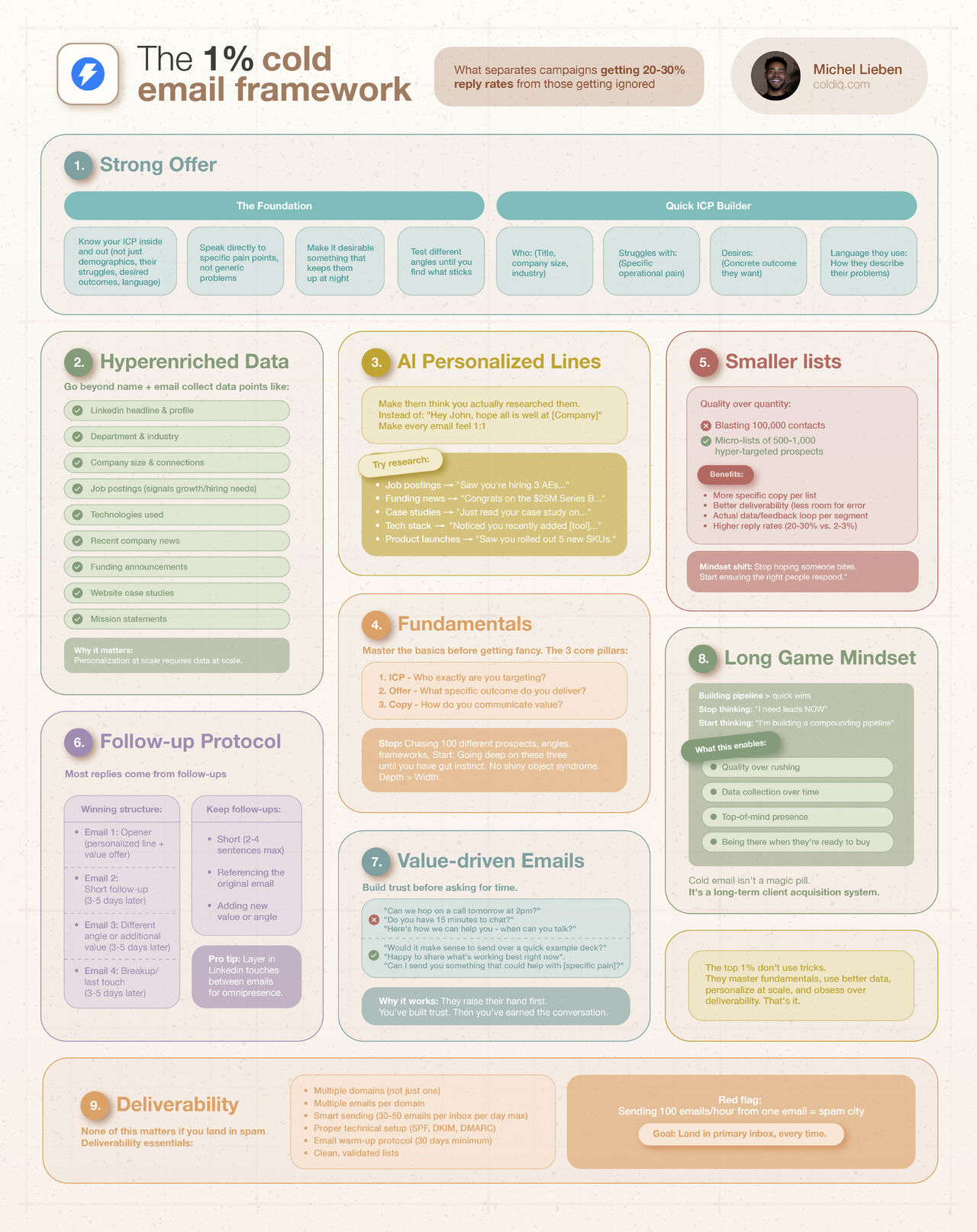
Based on 1,000,000+ emails analyzed via Instantly.ai, here is what the best-performing campaigns had in common.
These are not theoretical best practices. They are patterns extracted from real data across campaigns that actually generated pipeline. The gap between the top performers and everyone else comes down to these nine things.
1. Small Targeted Lists Beat Big Broad Lists
Micro-lists of 500-1,000 hyper-targeted prospects beat blasting 100,000 contacts every time.
Reply rates tell the story. Targeted lists generate 20-30% reply rates. Broad lists generate 2-3%.
The math works differently than most people expect. A list of 500 prospects with a 25% reply rate produces 125 conversations. A list of 100,000 with a 2% reply rate produces 2,000 conversations, but the quality is dramatically lower and the deliverability damage is real. Most of those 100,000 emails end up in spam, burn your domain reputation, and reduce future deliverability across all campaigns.
The best operators spend more time building the list and less time writing emails. When the list is specific enough, the list becomes the message.
2. Hyperenriched Data Over Basic Data
Going beyond name and email is what separates the top 1% from everyone else.
The best campaigns collect:
→ LinkedIn headline and profile data
→ Job postings that signal growth or hiring needs
→ Technologies the company is currently using
→ Funding announcements and investment rounds
→ Website case studies and customer stories
This depth of data is what makes genuine personalization possible. You cannot write a relevant first line if all you know is someone's name and company.
Clay handles most of this enrichment by aggregating data from multiple providers. Prospeo.io and FullEnrich fill gaps on contact data. Running them in a waterfall maximizes coverage.
Prospeo.io & FullEnrich power our mini tools where you can find verified emails & phone numbers, you can try them below, for free:
Email Finder Tool
Your target's information
Fields marked with * are required
Enter just the domain (e.g., company.com) or paste a website URL
Please enter a professional email address
Please fill in all required fields
Phone Finder Tool
FIND PEOPLE
Type domains, select personas, fetch real contacts.
Type LinkedIn company domain and press Enter to add
Persona 1
Define specific job titles and seniority levels to target the right decision makers
3. AI Personalization Over Generic Openers
"Hey John, hope all is well at [Company]" does not count as personalization. Every prospect receives dozens of emails that start this way.
The top campaigns use specific data points to make each email feel 1:1:
→ Job postings: "Saw you are hiring 3 AEs, which usually means outbound is working and you need to scale it."
→ Funding news: "Congrats on the $25M Series B. Most companies at this stage start investing heavily in outbound."
→ Case studies: "Just read your case study on reducing churn by 40%. We helped a similar company do the same for their pipeline."
→ Tech stack: "Noticed you recently added [tool]. Companies that adopt it usually run into [specific challenge]."
Each of these openers answers "why you, why now" in the first sentence. The prospect immediately understands why they received this email and not someone else.
4. Multi-Step Sequence Over a Single Email
Most replies come from the first emails, but follow-ups increase overall sequence reply rates significantly.
The structure that works:
→ Email 1: Personalized opener + value offer
→ Email 2: Short follow-up, 3-5 days later
→ Email 3: Different angle, 3-5 days later
→ Email 4: Breakup email, 3-5 days later
Keep every email short. Two to four sentences. Reference the original email. Add new value with each follow-up instead of just asking "did you see my last email?"
The best operators also layer in LinkedIn touches between emails. A connection request after email 1, a profile view after email 2, a comment on their content after email 3. By the time email 4 arrives, the prospect has seen your name in multiple places.
5. Value-First Over Ask-First
Stop asking for their time immediately.
These do not work:
→ "Can we hop on a call tomorrow at 2pm?"
→ "Do you have 15 minutes to chat?"
These do:
→ "Would it make sense to send over a quick example deck?"
→ "Happy to share what is working best right now."
→ "Can I send you something that could help with [specific pain]?"
The difference is who carries the burden. A call requires 15-30 minutes of their time with no guarantee of value. Sending something useful costs them nothing. They raise their hand first. Then you have earned the conversation.
6. Fundamentals Over Fancy Tactics
The top 1% master three core pillars:
→ ICP: Who exactly are you targeting? The more specific, the better.
→ Offer: What specific outcome do you deliver? Not features. Outcomes.
→ Copy: How do you communicate value in under 75 words?
Every failed campaign we analyze has a weakness in at least one of these three. Usually the ICP is too broad, the offer is too vague, or the copy sounds like it came from a marketing team.
Depth beats width. Nail these three things before experimenting with anything else.
7. Long Game Over Quick Wins
Cold email is not a magic pill. It is a compounding client acquisition system.
The first campaign rarely produces breakthrough results. The second campaign is better because you learned from the first. By the fifth campaign, your targeting is sharper, your copy is tighter, and your data is cleaner.
The operators generating consistent pipeline treat cold email as infrastructure, not a one-off tactic. They run campaigns continuously, test variables systematically, and optimize based on data rather than gut feeling.
Quality over rushing. Pipeline over quick wins. Be there when they are ready to buy.
8. Deliverability Over Volume
None of the above matters if you land in spam.
The technical fundamentals:
→ Multiple domains, not just one
→ 30 emails per inbox per day maximum
→ Proper technical setup: SPF, DKIM, DMARC
→ 30 days minimum warm-up before sending
→ Clean, validated lists with no invalid addresses
Sending 100 emails per hour from one inbox is the fastest way to destroy your domain reputation. The top operators spread volume across multiple inboxes, warm each one properly, and monitor deliverability metrics continuously.
You can check whether your emails will actually land in the inbox before sending, for free:
Spam Checker Tool
Fields marked with * are required
9. The Stack
The best-performing campaigns in this dataset ran on three core tools:
→ Instantly.ai for sequencing, deliverability management, and campaign analytics
→ Clay for data enrichment, intent signals, and personalization at scale
→ Prospeo.io for list building and targeting
That is it. Three tools. The complexity is not in the stack. It is in how you configure the targeting, write the copy, and maintain deliverability over time.
If you want to understand where your cold email and GTM motion stands today, you can get a full breakdown here: