.svg)

AI agents are replacing individual tasks. But the real shift is happening when agents work together.
The smartest agents do not work alone. They work in teams. Some behave like assistants. Others act as managers. And just like human teams, there are different ways to structure their collaboration. The setup you choose determines how fast, reliable, and autonomous your agent workflow becomes.
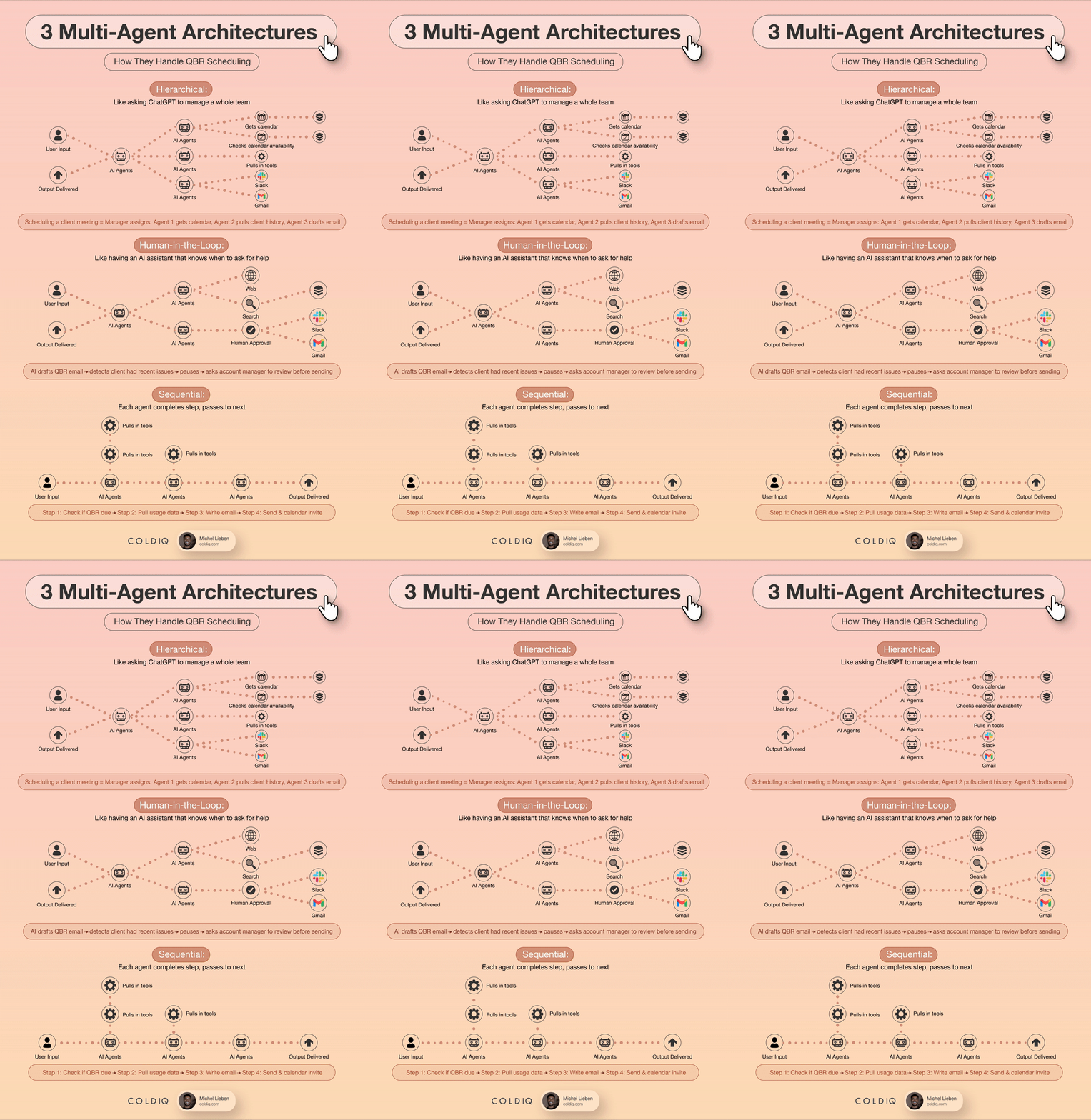
To illustrate this, we can look at how three multi-agent setups handle the exact same task: scheduling a quarterly business review with an important client.
This is a task that involves checking availability, pulling product usage data, drafting a personalized email, and sending it. Simple enough for a human. But when agents handle it, the structure of the team changes the outcome entirely.
1. Hierarchical Setup: A Manager Agent Running the Show
In a hierarchical setup, one agent acts as the manager. It receives the task, breaks it down, and assigns each sub-task to a specialized agent underneath it.
Here is how it handles the quarterly business review:
The manager agent receives the task: schedule a business review with the client. It tells a subordinate agent to check potential meeting times based on both calendars. A second agent pulls product usage data from the client's account. Has usage dropped recently? Is engagement still strong? A third agent drafts a personalized email that references both the client's availability and their product usage: "Hey Achilles, it is been a while. Wanted to ensure you are using the product to the fullest. How about a quick chat next week, Wednesday?" The manager reviews everything, approves the email, and sends it.
The key characteristic here is centralized control. The manager sees the full picture. It coordinates timing, resolves conflicts between agents, and makes the final call before anything goes out.
In a GTM context, this is how complex outbound sequences work when built inside tools like Clay or Relevance AI. A central workflow orchestrates data enrichment, signal detection, and email personalization, with each step handled by a different agent or automation, all reporting back to a master workflow that approves the final output.
Hierarchical setups work well when:
→ The task involves multiple steps that depend on each other
→ Quality control matters and a single agent needs to review the final output
→ Different types of expertise are needed (data, writing, scheduling)
→ The workflow is complex enough that no single agent can handle it alone
We built a mini-tool that helps you brainstorm the kind of multi-step campaigns these hierarchical setups are perfect for.
You can generate campaign ideas based on your ICP and outreach strategy in seconds, for free:
Campaign Ideation Tool
Enter your email to generate your campaign ideas.
2. Human-in-the-Loop Setup: A Smart Assistant That Taps Your Shoulder
The human-in-the-loop setup gives the agent autonomy for routine decisions but pauses for human input when the stakes are high.
Here is the same quarterly business review:
The agent drafts the business review email and finds available meeting times. But while pulling account data, it sees the client submitted negative feedback two weeks ago. Instead of sending the email as drafted, the agent pauses and asks: "This client left negative feedback recently. Do you want to review the email before I send it?" You review the draft, adjust the tone to acknowledge recent concerns, and approve the send.
The agent did 90% of the work. But at the critical moment, it knew to involve a human.
This is the setup B2B teams should default to for anything client-facing. Outbound emails to enterprise accounts, renewal conversations, responses to inbound leads from high-value companies. These are situations where an off-tone message costs more than the time saved by full automation.
In practice, this is how tools like n8n and Relevance AI handle sensitive workflows. The automation runs until it hits a decision point that requires judgment, then routes to a human via Slack, email, or a dashboard notification. Once the human approves, the workflow continues.
Human-in-the-loop setups work well when:
→ The task involves sensitive or high-stakes communication
→ Context matters and the agent might miss nuance (recent complaints, contract negotiations, executive relationships)
→ You want automation speed but cannot afford mistakes
→ Compliance or legal review is required before sending
The tricky part is knowing where to place the human checkpoint. Too early, and you lose the efficiency gains. Too late, and a bad message goes out before you can catch it.
3. Sequential Setup: An Assembly Line Where Each Agent Does One Thing
The sequential setup is the simplest to understand. Each agent performs one task and passes the result to the next agent in line.
Here is the quarterly business review in sequential mode:
Agent 1 checks: "Is a quarterly business review due?" It looks at the client's last meeting date and confirms that a review is overdue. Agent 2 pulls the client's product usage data for the past quarter. Agent 3 takes the usage data and drafts a short, personalized email. Agent 4 sends the email to the client.
Each agent only sees its own step. Agent 3 does not know how Agent 1 decided the review was due. Agent 4 does not evaluate the quality of the email. The output of one becomes the input of the next, and the chain moves forward.
This is the structure behind most outbound automation workflows today. Clay workflows often run this way: find companies matching criteria, enrich contacts, score leads, generate personalized copy, push to a sending platform like Instantly or lemlist. Each step feeds the next in a fixed order.
Sequential setups work well when:
→ The workflow has clear, ordered steps with no ambiguity
→ Each step produces a clean output the next step can consume
→ Speed matters more than nuance
→ The task is repeatable and predictable (weekly reports, list building, data enrichment)
The weakness is that no single agent has the full picture. If the usage data reveals a serious problem, Agent 3 might still draft a cheerful email because it has no context beyond the data it received. There is no manager reviewing the whole chain and no human to catch edge cases.
Based on the signals and data that feed these sequential workflows, we built a tool to help you detect the buying triggers that determine whether outreach is worth sending.
You can track which companies are actively researching solutions in your space, for free:
Intent Signals Tool
Fields marked with * are required
Quick examples:
4. When to Use Which Setup
Choosing between these three structures comes down to two variables: complexity and risk.
For complex, multi-step tasks where different types of work need to come together, the hierarchical setup gives you coordination and quality control. A manager agent catches conflicts, resolves dependencies, and ensures the final output makes sense as a whole.
For high-stakes, sensitive tasks where a mistake carries real cost, the human-in-the-loop setup gives you speed without sacrificing judgment. The agent handles the routine work. You handle the decisions that matter.
For ordered workflows with clear dependencies and predictable outcomes, the sequential setup gives you speed and simplicity. Each agent does one thing well. The chain moves fast.
In practice, the best GTM systems combine all three. A hierarchical setup might manage the overall campaign. Within it, certain steps run sequentially (enrichment, scoring, copy generation). And at critical decision points, a human reviews before the final send.
Tools like Clay, Relevance AI, and n8n already support these patterns. The question is not whether to use agents. It is how to structure the team.
5. Building Your First Multi-Agent Workflow
Starting with multi-agent setups does not require building everything from scratch. The pattern is the same regardless of scale:
→ Identify a repeatable task that involves more than one step
→ Map each step to an agent or automation
→ Decide where humans need to be involved
→ Choose the structure that fits the risk and complexity level
→ Test with a single workflow before expanding
For outbound, the most common starting point is a sequential chain: source leads, enrich data, personalize copy, send. From there, you add a human-in-the-loop checkpoint before sending to high-value accounts. And as the system matures, a hierarchical manager agent coordinates multiple campaigns running in parallel.
The teams that figure out multi-agent collaboration first will operate at a speed and consistency that manual workflows cannot match. The agents are ready. The question is how you structure them.
If you want to see where your GTM motion stands and which workflows would benefit from agent automation, you can get a full breakdown here: